
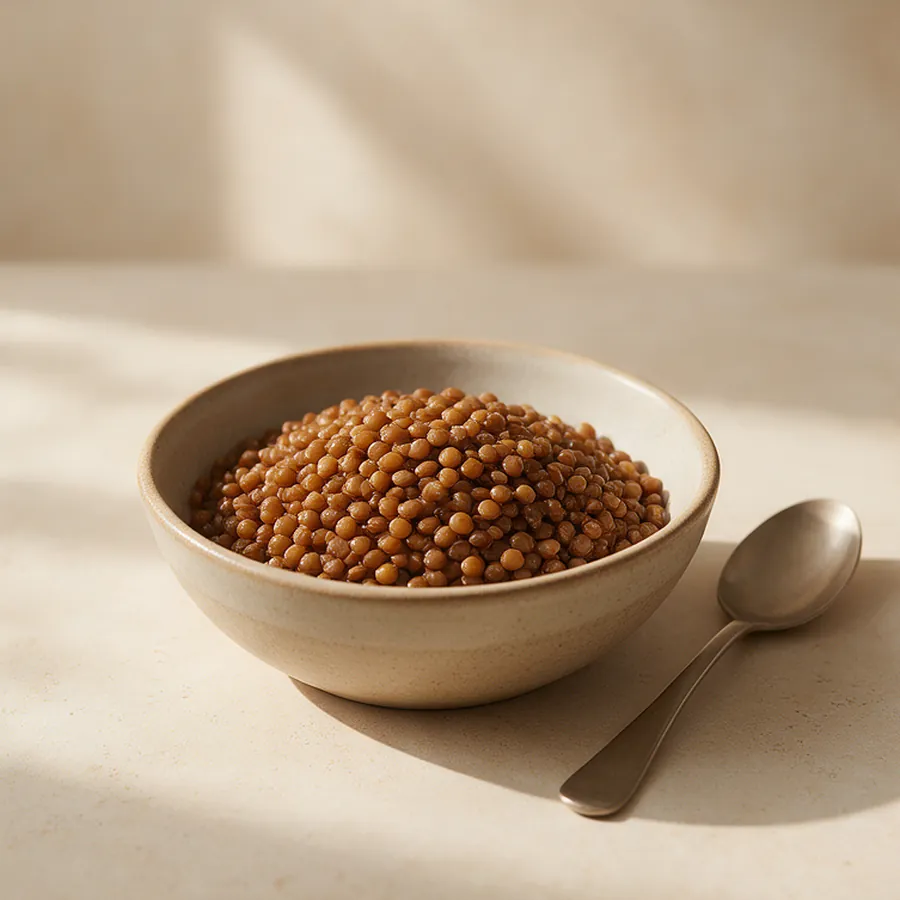
Every fiber chart online ranks foods per 100 g, which is how chia seeds end up at the top and nobody learns anything about dinner. This chart gives both: fiber per the serving you would actually eat and per 100 g for a like-for-like comparison, from the USDA FoodData Central database, rounded to the nearest 0.5 g, with the form stated because a cooked lentil and a dry one are different numbers.
It is not a ranking of good and bad; it is a map, and the three recipes at the end show how an ordinary lunch and dinner reach 12 to 15 g without a single large bowl of beans. The same data drives the food finder and the checker.
Legumes
| Food | Serving | Fiber per serving | Per 100 g | Form |
|---|---|---|---|---|
| Split peas | 1 cup, 196 g | 16 g | 8 g | boiled |
| Lentils | 1 cup, 198 g | 15.5 g | 8 g | boiled |
| Black beans | 1 cup, 172 g | 15 g | 8.5 g | boiled |
| Chickpeas | 1 cup, 164 g | 12.5 g | 7.5 g | boiled from dried |
| Kidney beans | 1 cup, 177 g | 11.5 g | 6.5 g | boiled |
| Edamame | 1 cup, 155 g | 8 g | 5 g | boiled from frozen |
| Chickpeas, canned | half a can, 120 g | 7.5 g | 6.5 g | drained and rinsed |
| Baked beans | half a can, 200 g | 7.5 g | 4 g | canned in sauce |
| Hummus | 2 tablespoons, 30 g | 2 g | 6 g | prepared |
Canned or dried? Canned beans carry a little less fiber per 100 g than home-cooked, because of the water they absorb in the can and the processing, and they carry more salt; rinsing removes most of the salt and some of the oligosaccharides that cause gas. For most people the difference that matters is that canned beans get eaten and dried ones sit in the cupboard. Half a can, rinsed, is a good portion to start with.
Whole grains, and the refined versions beside them
| Food | Serving | Fiber per serving | Per 100 g | Form |
|---|---|---|---|---|
| Bulgur wheat | 1 cup, 182 g | 8 g | 4.5 g | soaked or boiled |
| Wholewheat pasta | 1 cup, 140 g | 6.5 g | 4.5 g | boiled |
| White pasta | 1 cup, 140 g | 2.5 g | 2 g | boiled |
| Pearl barley | 1 cup, 157 g | 6 g | 4 g | boiled |
| Wholewheat cereal biscuits | 2, 47 g | 6 g | 12.5 g | dry |
| Quinoa | 1 cup, 185 g | 5 g | 3 g | boiled |
| Rolled oats | 40 g | 4 g | 10 g | dry |
| Oat bran | quarter cup, 24 g | 3.5 g | 15 g | dry |
| Popcorn, air-popped | 3 cups, 24 g | 3.5 g | 14.5 g | popped |
| Brown rice | 1 cup, 202 g | 3.5 g | 1.5 g | boiled |
| White rice | 1 cup, 158 g | 0.5 g | 0.5 g | boiled |
| Wholegrain bread | 1 slice, 36 g | 2 g | 6 g | commercial |
| Rye bread | 1 slice, 32 g | 2 g | 6 g | commercial |
| White bread | 1 slice, 30 g | 1 g | 3 g | commercial |
Wholegrain against refined: the swap from white to wholewheat pasta adds 4 g to the same plate; white to brown rice adds 3 g; white to wholegrain bread adds about 1 g a slice. Nothing new to cook, nothing new to learn. Bread varies more than any other food on this chart; a dense seeded loaf can reach 4 g a slice, and the label per slice is the number that counts.
Fruit
| Food | Serving | Fiber per serving | Per 100 g | Form |
|---|---|---|---|---|
| Raspberries | 1 cup, 123 g | 8 g | 6.5 g | fresh or frozen |
| Blackberries | 1 cup, 144 g | 7.5 g | 5 g | fresh or frozen |
| Avocado | half, 100 g | 6.5 g | 6.5 g | raw |
| Pear, with skin | 1 medium, 178 g | 5.5 g | 3 g | raw |
| Apple, with skin | 1 medium, 182 g | 4.5 g | 2.5 g | raw |
| Blueberries | 1 cup, 148 g | 3.5 g | 2.5 g | fresh or frozen |
| Prunes | 5, 48 g | 3.5 g | 7 g | dried |
| Banana | 1 medium, 118 g | 3 g | 2.5 g | raw |
| Orange | 1 medium, 131 g | 3 g | 2.5 g | raw, whole |
| Kiwi | 1 fruit, 69 g | 2 g | 3 g | raw |
| Orange juice | 1 glass, 248 g | 0.5 g | 0 g | juice |
Whole fruit against juice: an orange carries 3 g; its juice carries almost none, because the fiber is the pulp and pith the juicer discards. Frozen berries are picked ripe, cost less, and carry the same fiber as fresh.
Vegetables
| Food | Serving | Fiber per serving | Per 100 g | Form |
|---|---|---|---|---|
| Green peas | 1 cup, 160 g | 9 g | 5.5 g | boiled from frozen |
| Broccoli | 1 cup, 156 g | 5 g | 3.5 g | steamed |
| Spinach | 1 cup, 180 g | 4.5 g | 2.5 g | wilted |
| Sweetcorn | 1 cup, 164 g | 4.5 g | 3 g | boiled |
| Brussels sprouts | 1 cup, 156 g | 4 g | 2.5 g | roasted or steamed |
| Potato, with skin | 1 medium, 173 g | 4 g | 2.5 g | baked |
| Sweet potato, with skin | 1 medium, 114 g | 4 g | 3.5 g | baked |
| Carrots | 1 cup, 128 g | 3.5 g | 3 g | raw |
| Cabbage | 1 cup, 150 g | 3 g | 2 g | boiled or stir-fried |
Frozen peas are the cheapest 9 g in the shop. Potatoes count, with the skin on.
Nuts and seeds
| Food | Serving | Fiber per serving | Per 100 g | Form |
|---|---|---|---|---|
| Chia seeds | 2 tablespoons, 28 g | 9.5 g | 34 g | dry |
| Ground flaxseed | 2 tablespoons, 14 g | 4 g | 27.5 g | ground |
| Almonds | 30 g | 3.5 g | 12.5 g | raw, with skin |
| Dark chocolate, 70 to 85 percent | 30 g | 3 g | 11 g | bar |
| Sunflower seeds | 30 g | 2.5 g | 8.5 g | hulled |
| Pumpkin seeds | 30 g | 2 g | 6.5 g | hulled |
| Walnuts | 30 g | 2 g | 6.5 g | raw |
| Peanut butter | 2 tablespoons, 32 g | 1.5 g | 5 g | smooth or crunchy |
This is the category where per 100 g misleads: chia tops every chart at 34 g per 100 g and nobody eats 100 g of chia. Two tablespoons, soaked, is the serving, and one tablespoon is the sensible start.
Three recipes, with the fiber counted
Chickpea and bulgur salad with tahini, 14 g per serving
Serves 2, 15 minutes. 100 g dry bulgur (soak in 200 ml boiling water, covered, 10 minutes), half a can of chickpeas rinsed (120 g), 150 g cherry tomatoes halved, half a cucumber diced, a handful of parsley, 2 tablespoons tahini whisked with the juice of half a lemon, 2 tablespoons water and a pinch of salt. Toss. Fiber per serving: bulgur 8 g, chickpeas 3.5 g, vegetables 2.5 g, tahini 1 g, about 14 g. Keeps two days; swap the bulgur for quinoa to make it gluten-free (about 11 g). Chickpeas are among the more fermentable foods, so a quarter can per serving is the gentler start.
Red lentil and vegetable soup with rye bread, 12 g per serving
Serves 4, 30 minutes. 200 g dry red lentils, 1 onion, 2 carrots and 1 celery stick diced, 2 cloves garlic, a teaspoon of cumin, 1 litre vegetable stock, a tin of chopped tomatoes, a squeeze of lemon. Soften the vegetables in a tablespoon of oil for 8 minutes, add the spices, lentils, stock and tomatoes, simmer 20 minutes, blend half. Serve with a slice of rye. Fiber per serving: lentils about 7 g, vegetables and tomato 3 g, bread 2 g, about 12 g. Freezes well. Onion and garlic are fructan sources; leave them out and use the green tops of spring onions if they are a known problem.
Brown rice, black beans and roasted vegetables, 15 g per serving
Serves 2, 35 minutes. 150 g dry brown rice, half a can of black beans rinsed (120 g), 300 g mixed sweet potato, pepper and red onion roasted at 220 C with a tablespoon of oil and smoked paprika for 25 minutes, a handful of spinach wilted through, lime and coriander. Fiber per serving: rice 3.5 g, beans 7 g, vegetables 4.5 g, about 15 g. Packs for work in a glass container; the beans can be halved on a first week.
What the research says
- Reynolds and colleagues, The Lancet, 2019, a series of systematic reviews and meta-analyses of 185 prospective studies and 58 trials in adults, 25 to 29 g of dietary fiber a day from whole foods: associated with 15 to 30 percent lower all-cause mortality and lower incidence of coronary heart disease, type 2 diabetes and colorectal cancer, with a dose response. The contrary finding: observational for mortality, and thinner data above 30 g a day. doi.org/10.1016/S0140-6736(18)31809-9
- Dahl and Stewart, Journal of the Academy of Nutrition and Dietetics, 2015, position paper for US adults, 14 g of fiber per 1,000 kcal recommended against an average intake of about 17 g: most adults eat around half the recommended fiber. The contrary finding: increasing fiber quickly causes gas and bloating, and gradual increases with fluids are advised. doi.org/10.1016/j.jand.2015.09.003
- Whitehead and colleagues, The American Journal of Clinical Nutrition, 2014, meta-analysis of 28 randomised trials, at least 3 g of oat beta-glucan a day (about 70 to 80 g of rolled oats) over 2 to 12 weeks: LDL cholesterol fell by 0.25 mmol/L. The contrary finding: HDL and triglycerides did not change, and the effect was larger at higher starting values. doi.org/10.3945/ajcn.114.086108
Questions people ask
Which vegan food has the most fiber? Per serving you would eat, split peas and lentils at 15 to 16 g a cup; per 100 g, chia seeds at 34 g. The useful answer is the first one.
Are canned beans as good as dried? Nearly, for fiber, and better for actually getting eaten. Rinse them.
How much fiber is in oats? 4 g in a 40 g serving of rolled oats, about 10 g per 100 g dry; oat bran is 15 g per 100 g. The beta-glucan that lowered cholesterol in the Whitehead meta-analysis needed about 70 to 80 g of oats a day.
Does cooking destroy fiber? No. Cooking changes weight and volume, which is why cooked and dry values differ so much per 100 g, but the fiber survives.